

What is the difference between a modulating and an on - off three way control valve?
As a supplier of Three Way Control Valves, I often encounter customers who are confused about the differences between modulating and on - off three way control valves. Understanding these differences is crucial for selecting the right valve for specific applications. In this blog post, I will delve into the details of these two types of valves, highlighting their characteristics, advantages, and typical use cases.
Basic Definitions
Let's start by defining what a three - way control valve is. A Three Way Control Valve is a device that can control the flow of a fluid (liquid or gas) by diverting it between two outlet ports or mixing fluids from two inlet ports into one outlet port. The "three - way" refers to the three ports on the valve: one common port and two other ports.
An on - off three way control valve is designed to operate in two states: fully open or fully closed. It is like a simple switch. When the valve is in the "on" position, it allows the fluid to flow through a specific path, and when it is in the "off" position, it stops the flow.
On the other hand, a modulating three way control valve can vary the flow rate continuously between fully open and fully closed positions. It can precisely control the amount of fluid flowing through each port according to the system requirements.
Operating Principle
The operating principle of an on - off three way control valve is relatively straightforward. It is usually actuated by an electric, pneumatic, or hydraulic actuator. When a signal is sent to the actuator, it moves the valve disc to either the fully open or fully closed position. For example, in a heating system, an on - off three way control valve can be used to switch the flow of hot water between two different circuits. When the room temperature is below the set point, the valve opens to allow hot water to flow into the heating circuit, and when the temperature reaches the set point, the valve closes.
A modulating three way control valve, however, operates based on a proportional control signal. The actuator of the modulating valve can move the valve disc to any position between fully open and fully closed in response to a control signal. This signal is typically a 4 - 20 mA current or a 0 - 10 V voltage. For instance, in a chemical process where the mixing ratio of two fluids needs to be precisely controlled, a modulating three way control valve can adjust the flow rates of the two fluids continuously to achieve the desired ratio.
Advantages and Disadvantages
On - Off Three Way Control Valves
- Advantages
- Simplicity: They are relatively simple in design and operation. This makes them easy to install, maintain, and troubleshoot.
- Cost - effective: Generally, on - off three way control valves are less expensive than modulating valves. They are a good choice for applications where precise flow control is not required.
- Reliability: Since they have fewer moving parts and operate in only two states, they are less prone to mechanical failures.
- Disadvantages
- Limited control: They can only provide binary control (on or off), which may not be suitable for applications that require fine - tuned flow control.
- Oscillation: In some systems, the on - off operation can cause oscillations in the process variables. For example, in a temperature control system, the temperature may fluctuate around the set point due to the sudden opening and closing of the valve.
Modulating Three Way Control Valves
- Advantages
- Precise control: They can provide accurate and continuous control of the flow rate, which is essential for applications such as temperature control, pressure control, and flow ratio control.
- Smooth operation: Modulating valves can prevent sudden changes in the system, resulting in a more stable process. This can improve the quality of the final product in industrial processes.
- Energy efficiency: By precisely controlling the flow rate, modulating valves can help reduce energy consumption. For example, in a HVAC system, a modulating valve can adjust the flow of chilled water according to the actual cooling load, saving energy.
- Disadvantages
- Higher cost: Modulating three way control valves are more expensive than on - off valves due to their more complex design and the need for a proportional actuator.
- Complex maintenance: They require more sophisticated maintenance and calibration procedures. Any malfunction in the actuator or the control system can affect the performance of the valve.
Typical Applications
On - Off Three Way Control Valves
- Domestic heating systems: As mentioned earlier, on - off three way control valves are commonly used in home heating systems to switch the flow of hot water between different radiators or heating zones.
- Simple industrial processes: In some industrial processes where the flow control requirements are not very strict, such as in a simple water transfer system, on - off three way control valves can be used.
Modulating Three Way Control Valves
- Chemical and pharmaceutical industries: In these industries, precise control of the mixing ratio of different chemicals is crucial for product quality. Modulating three way control valves are used to ensure accurate and continuous mixing.
- Power generation: Extraction Valve Steam Turbine and High Pressure Bypass Valve systems often use modulating three way control valves to control the steam flow and pressure, ensuring the stable operation of the power plant.
- HVAC systems: In large commercial and industrial HVAC systems, modulating three way control valves are used to control the flow of chilled water or hot water to maintain a constant temperature and humidity.
Selecting the Right Valve
When selecting between a modulating and an on - off three way control valve, several factors need to be considered.
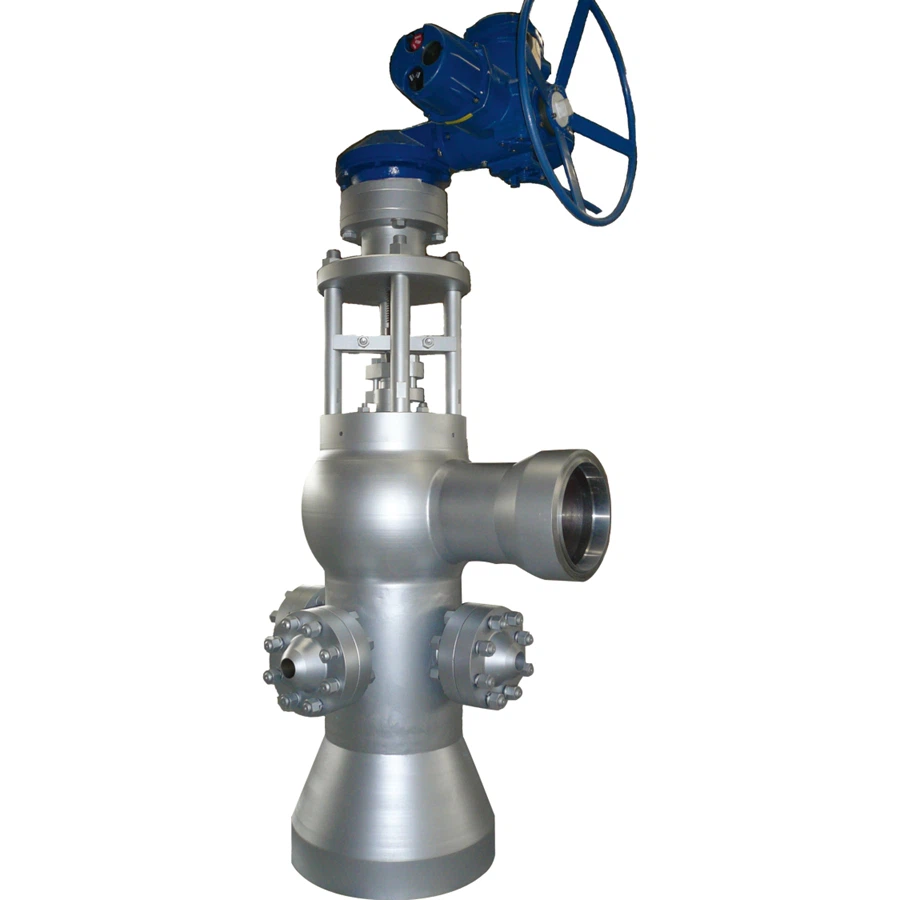

- Control requirements: If precise and continuous control of the flow rate is required, a modulating valve is the better choice. However, if only binary control is needed, an on - off valve can be sufficient.
- Cost: Budget is always an important consideration. On - off valves are generally more cost - effective, but if the benefits of precise control outweigh the additional cost, a modulating valve may be worth the investment.
- System complexity: In a simple system, an on - off valve may be easier to integrate and operate. In a complex system with multiple variables to control, a modulating valve can provide better overall performance.
As a supplier of Three Way Control Valves, we have a wide range of products to meet different customer needs. Whether you need an on - off three way control valve for a simple application or a high - precision modulating valve for a complex industrial process, we can provide you with the right solution. If you are interested in our products or have any questions about valve selection, please feel free to contact us for procurement and further discussion.
References
- "Control Valves: Sizing, Selection, and Application" by John R. Belaire
- "Industrial Valves: A Practical Guide" by Robert E. Scheidt
